Field notes · Look · Try · Compare
Noticing horizontal lines in a photograph
Follow ledges, railings, and display edges across the frame.

Woman in Blue Costume Sitting on Bench · Photograph: Yenra
Captured: 2020:01:03 13:56:10
A line that travels across a photograph gives your eyes somewhere to go. It might be a ledge under a seated model, a railing behind a costume, or the edge of an illuminated sign. Begin by following one line, then notice how the rest of the picture meets it.
Follow the ledge across a portrait
The blue costume sits above a broad, dark ledge. Follow the ledge from the left of the photograph toward the model, then continue along it to the right. The pale railing and wall behind offer more edges travelling across the scene.
The model gives those lines a point of interruption. A body, a bent leg and the hanging blue fabric introduce other shapes. You can read the ledge as a connection across the frame while still returning to the person sitting on it.
Try looking at the picture twice. First, follow only the dark ledge. Then begin with the face and see where your attention goes next. A line can be useful even when it is not the first thing you notice.
Horizontal here describes a direction within the photograph. It is different from landscape orientation, which describes the wider-than-tall shape of the image, and from a horizon, where distant land or water appears to meet the sky. A portrait-oriented image can contain horizontal lines too.
For a small experiment, find a table edge or a shelf. Notice where it crosses the frame before adding anything else. A familiar object resting above it can give that simple line a new relationship.
Compare a railing with the shapes above it
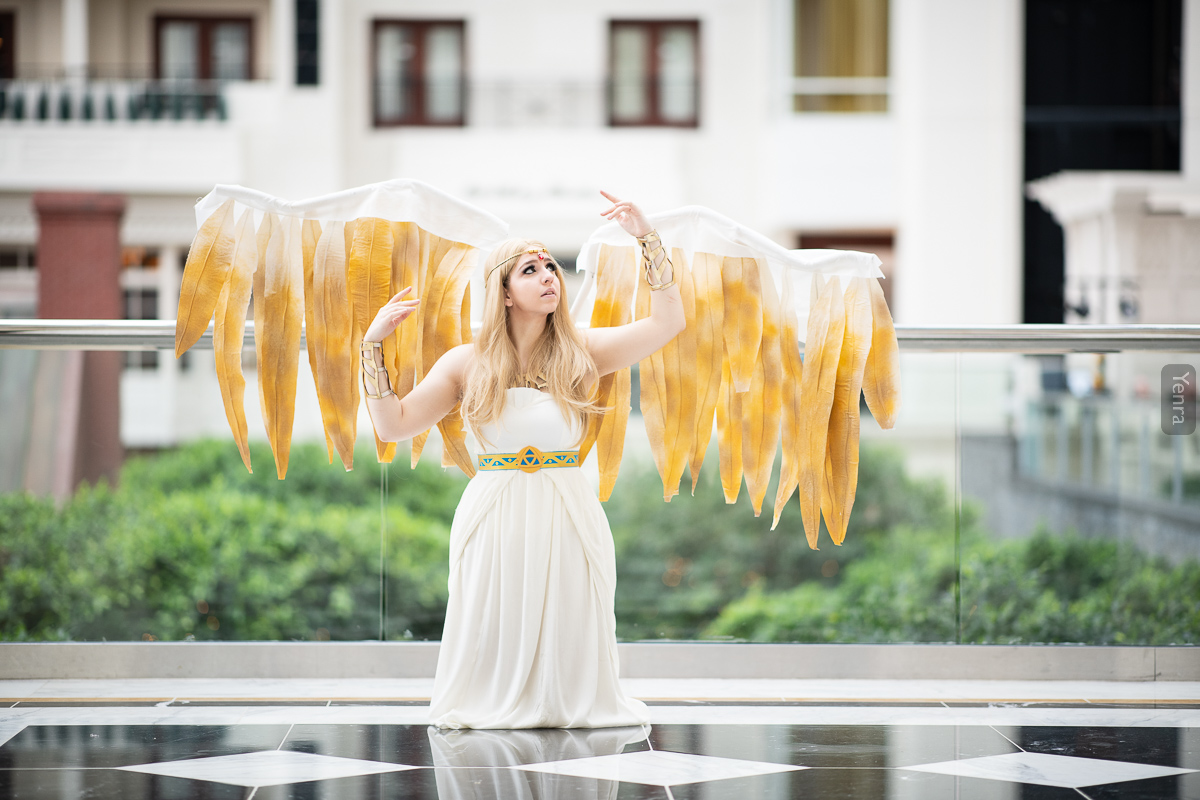
Winged Zelda, Breath of the Wild · Photograph: Yenra
Captured: 2020:01:04 11:34:21
In this Winged Zelda portrait, the glass railing runs behind the model. Above it, raised hands and gold-and-white wings introduce reaching and angled shapes. The line across the background gives you something to compare those directions with.
Trace the railing, then follow a wing upward. The photograph offers more than one route for your attention. You may enjoy the contrast between a long edge across the scene and the more intricate shapes of the costume.
Notice where the railing meets the figure. A small change in camera height, in a new photograph, could place an edge nearer a shoulder, a hand or a different part of the costume. That is a useful variable to explore with a willing model, without asking them to change their pose every time.
A line may slope slightly because of viewpoint and still carry your eye across the picture. You can appreciate that direction as it appears. There is no need to straighten or crop a photograph before learning from it.
Find a horizontal band in an event scene

MAGFest on Conference Display · Photograph: Yenra
Captured: 2020:01:03 08:12:53
The illuminated MAGFest display stretches between columns. Its edges and lettering gather attention across a bright band, while the columns and hanging lights introduce other directions around it.
This time there is no model to follow. The display itself provides the main subject, and its surroundings show how it sits within the venue. Horizontal lines can help you study an event scene as readily as a portrait.
Look at the space above and below the display. Then imagine changing your camera height for a scene of your own. You could give a broad band more room above it, place it lower in the frame, or include something that interrupts its path.
Describe what you see rather than giving every horizontal line the same mood. In one photograph it may feel steady to you; in another it may lead toward a lively gesture. Keep one specific observation about where your eye travels. That small discovery is a good starting point for another picture.
Look back with curiosity.
- Which line carries your eye across the picture?
- What interrupts or echoes that line?
- What changes when the line sits higher or lower in the frame?
Keep exploring
Noticing vertical lines in a photograph · Noticing horizons in a photograph · Following lines through a photograph
Browse the complete MAGFest 2020 gallery.