Field notes · Look · Try · Compare
Noticing pleats in a costume portrait
Follow repeating folds, bright edges and darker spaces within the larger shape of a costume.

Sailor Venus, Sailor Senshi, Sailor Moon · Photograph: Yenra · Credit: Jenni Bon · Archive tags: Jenni Bon
Captured: 2016:06:04 19:15:26
Pleats give your eye a rhythm to follow within a costume portrait. Bright edges and darker spaces repeat across the fabric, then join the much larger shapes made by a skirt, a pose and the surrounding scene. Looking at both scales can reveal a detail you enjoy in a photograph you already know.
These Colossalcon 2016 photographs offer three different views of pleated skirts. Begin with a few neighboring folds, then return to each complete portrait. You can explore what is visible with an existing photograph and a brief note.
Find repetition within a broad shape
The orange skirt forms a broad area beneath the white bodice. Within it, bright fold edges alternate with darker channels. Behind the figure, the arcade grid offers another kind of repetition, so the photograph contains more than one pattern for your eye to follow.
Start with two adjacent folds and compare their widths and brightness. Then look at the skirt as one larger shape. The small repeated lines can help you see how the garment spreads within the portrait, while the face and forward-reaching hand offer other points of attention.
Write one concrete observation, such as “bright edges repeat across an orange shape.” Then look again at the complete image. A useful note can describe what you see while leaving room for another discovery.
See how a turn changes the folds
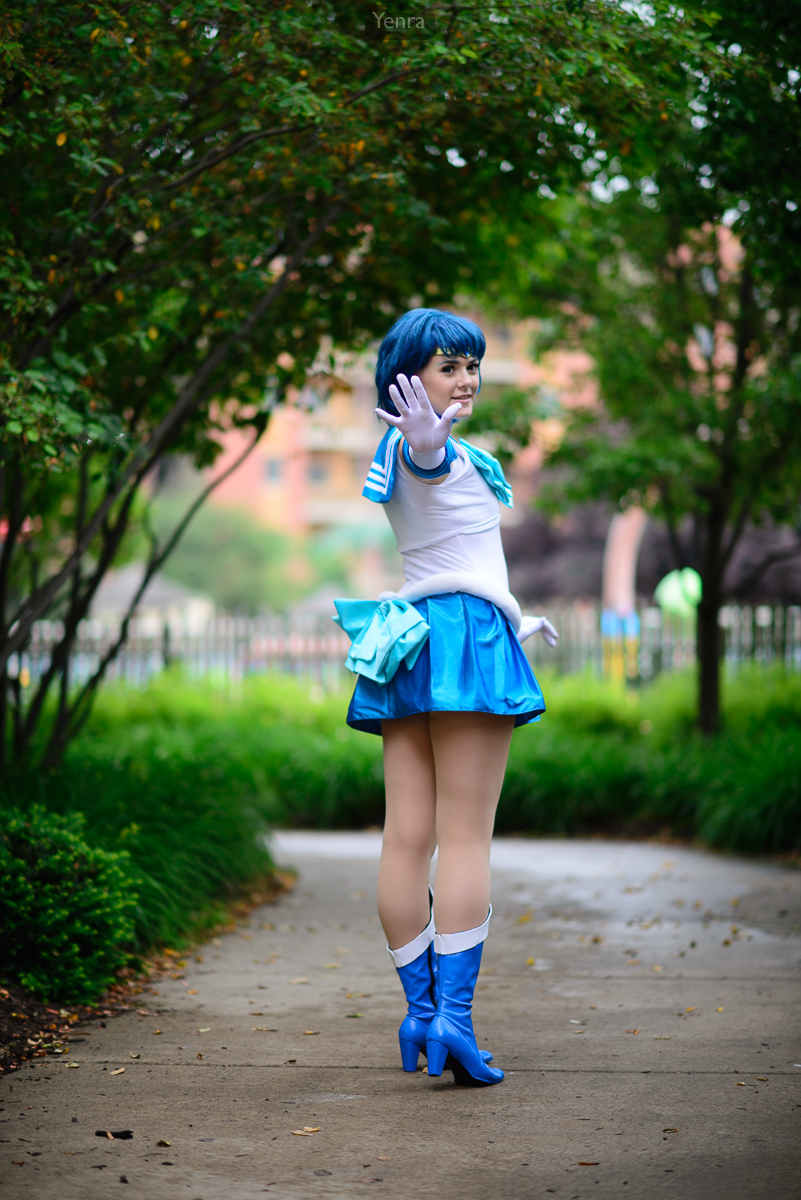
Sailor Mercury, Sailor Senshi, Sailor Moon · Photograph: Yenra · Credit: Slothtier Cosplay · Archive tags: Slothtier Cosplay
Captured: 2016:06:04 19:28:25
The blue skirt turns across the frame beside a large turquoise bow. Some folds show wider bright areas while others read as narrower dark lines. Their repetition belongs to a pose that also includes a raised gloved hand, blue hair and the green background.
Compare the folds with those in the orange skirt. These are different costumes, poses and surroundings, so several things contribute to the change. Choose one visible relationship to describe: the spacing between folds, their direction or how the bow interrupts the repeated lines.
A new view of a familiar garment can offer a different pattern. If you are making photographs with a willing partner, a small comfortable turn may give you something new to compare. You can also use two existing portraits and enjoy the differences already recorded.
Compare pleats within an open pose

Sailor Mars, Sailor Senshi, Sailor Moon · Photograph: Yenra · Credit: Flaming-Goddess Cosplay
Captured: 2016:06:04 19:29:19
The red pleats make a broad band beneath the white bodice. Their short repeated lines sit inside a much larger arrangement of outstretched arms and legs. The green setting gives the costume another area of color to meet at its edges.
Let your attention move from one fold to the outline of the skirt and then to the complete pose. At each scale, a different shape may become useful. The detail can add interest without needing to be the first thing every viewer notices.
Choose a photograph of your own and keep two notes: one about a repeated detail and one about the whole portrait. Those notes can guide your next experiment or simply help you appreciate more of the photograph in front of you.
Look back with curiosity.
- Where do the folds catch your attention?
- How does the repeated detail belong to the larger costume shape?
- What changes when you compare another whole portrait?
Keep exploring
Noticing texture in a photograph · Seeing clothing as shape · Noticing repeated motifs in a portrait
Browse the complete Colossalcon 2016 gallery. Follow a photograph into its original neighbors and see what else catches your attention. A repeated detail, an enjoyable gesture or a familiar prop can become the beginning of another experiment.