Field notes · Look · Try · Compare
Making a portrait at a table
Explore how a table, familiar objects and comfortable gestures can contribute to a portrait.
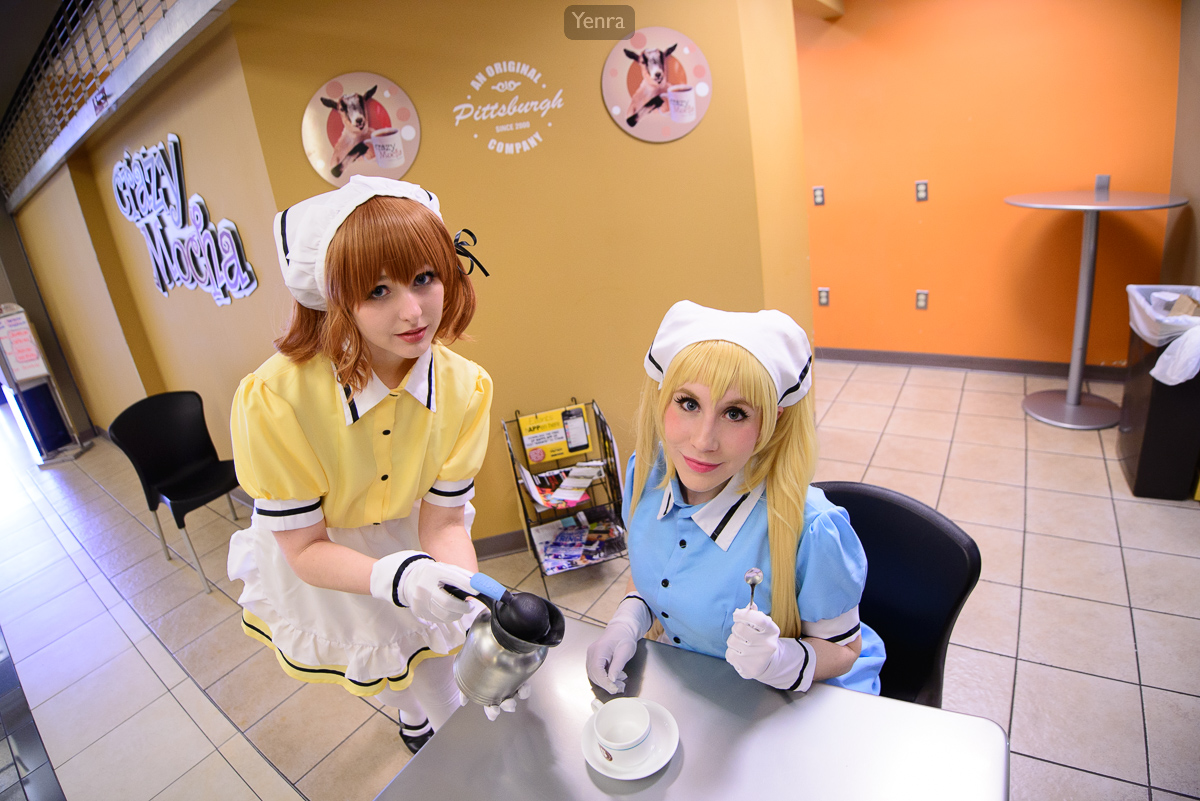
Mafuyu Hoshikawa and Kaho Hinta, Blend S · Photograph: Yenra
Captured: 2018:04:07 14:02:43
A table gives a portrait an everyday setting and a place for hands, objects and shared attention. You can explore how much of that setting to include, then move closer to see what changes around the faces.
These three Tekko 2018 photographs show two models in Blend S outfits at a small table. They form a new editorial comparison of wider framing, objects and a closer view. For your own experiment, an ordinary table and one willing model are enough to begin.
Give the table a place in the frame
The first view includes a standing model in yellow and a seated model in blue. A metal pot, cup and spoon appear near the center, with the tabletop extending toward the lower edge. Chairs, signs and surrounding walls help establish the setting.
Look at how the table brings the hands and objects into the same area. Its surface is a place where several parts of the portrait meet. Including the surrounding room gives those details a context you can recognize.
Begin your own portrait by choosing a comfortable position together. The model might sit beside the table or stand near it. Make a simple wider frame and see which parts of the setting you both enjoy.
Notice the edges as you compose. How much tabletop appears at the bottom? Is there room for a hand or object that matters to the picture? A small change in your position can give you another version to compare.
Notice hands and shared objects

Mafuyu Hoshikawa and Kaho Hinata of Blend S · Photograph: Yenra
Captured: 2018:04:07 14:05:33
In the second photograph, the models look toward each other across a tabletop holding an open notebook, a pen, a cup and other objects. The visible hands make several connections between the faces and the surface in front of them.
Follow one of those connections. A raised pen leads toward a face; the notebook gives the foreground a broad light shape. You can describe these relationships without needing to supply a conversation or story about what was happening.
For a new portrait, invite the model to choose a small activity that feels comfortable. Resting a hand beside a notebook, holding a familiar object or simply leaning an arm on the table can provide a starting point. Leave room for their own ideas.
If working with two models, look at how each person has space within the frame. They can look toward each other, toward the camera or elsewhere. Compare the arrangements together and keep the variations that interest you.
Try a closer view across the table
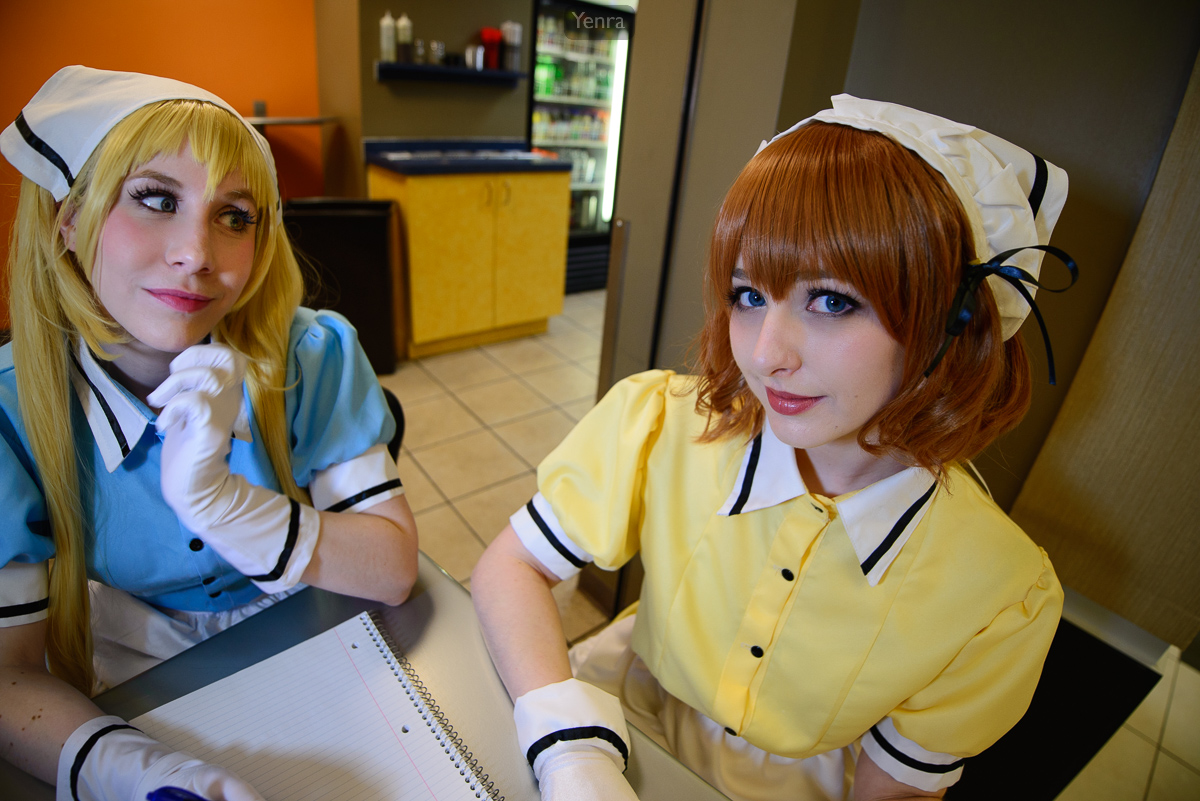
Mafuyu Hoshikawa and Kaho Hinata of Blend S · Photograph: Yenra
Captured: 2018:04:07 14:06:55
The closer photograph gives more space to faces, clothing and gloved hands. Part of the notebook remains at the bottom, keeping a connection with the tabletop even though less of the setting is visible.
Compare what is easy to notice in this frame with the wider first view. The surrounding room contributes less here, while smaller details of the faces become more prominent. The table still helps organize the lower part of the picture.
Try moving closer yourself rather than asking for a complicated new pose. Check that the model remains comfortable, then make another frame. You can also compare existing photographs at different distances without altering the original files.
Keep a wider and a closer version while you decide what each contributes. Perhaps one gives a stronger sense of place and another brings attention to a gesture. Both can be useful parts of the same session.
These examples preserve their supplied character titles and archive links. The observations are invitations to experiment with a table, people and familiar objects. Begin with the setting you have, agree on one small variation, and look back at the results together.
Look back with curiosity.
- How much tabletop helps the portrait?
- What do the hands and objects add to the arrangement?
- What changes when the frame moves closer to the faces?
Keep exploring
Photographing people together · Exploring props in a portrait
Browse the complete Tekko 2018 gallery.