Field notes · Look · Try · Compare
Looking through a foreground layer
Explore what a foreground surface lets you see, from a veil to the colored edge of a bubble.
A foreground surface can become part of a photograph while still letting something beyond it show through. A veil, a curtain, or a bubble gives you two things to enjoy at once: the material itself and the scene you can see through or around it. Start by looking at where those two meet.
Notice the layer itself.

A veil over pale clothing · Yenra Photography archive

A veil in the foreground · Yenra Photography archive
In the first photograph, a pale veil lies over a person seen from behind. Clothing and outlines remain visible through the fabric. An uncovered face and another person appear beside it, giving you places to compare the veiled and open parts of the view.
The second photograph brings the veil closer in the frame. It occupies the right side, while an uncovered face appears at left. Follow the fabric's edge and notice how much of the picture belongs to the material. The layer has a shape of its own, even where you can still make out clothing beyond it.
Compare what shows through and what stays outside.

A bubble above an open hand · Photograph: Yenra
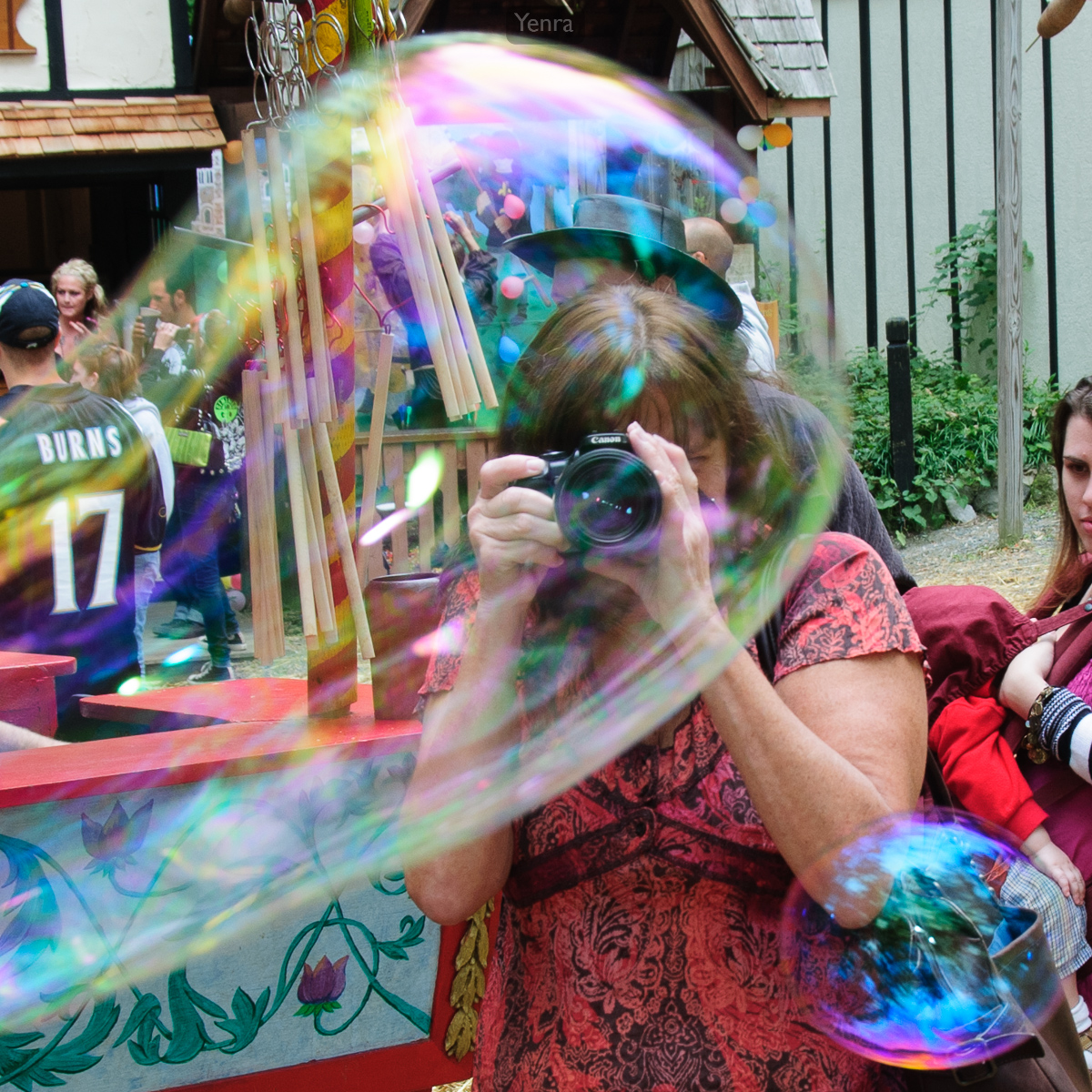
A camera seen through a bubble · Photograph: Yenra
The landscape photograph places a bubble above an open hand. The face remains outside the bubble at right. Colored marks and fragments of the surrounding scene give its surface something to look at, while the open space around it helps you follow its rounded boundary.
In the square photograph, a large bubble crosses the camera and its holder. Colored arcs share that part of the frame with the person beyond. Compare this overlap with the first bubble: which details are inside the boundary, and which remain outside? Both arrangements offer a different route through the picture.
You can use these photographs as invitations to look. Trace a surface, pause at what remains visible through it, then return to the whole scene. You may find that a small edge or a patch of color is as interesting as the subject behind it.
Try a familiar material.
A familiar object and a sheer curtain already in place, or a clear container on a table, give you a manageable starting point. Arrange your view so that part of the object sits beyond the material. Make a picture, then move slightly and see which parts overlap next.
Try giving the material more room, then less. Keep a view you enjoy and a note about what caught your attention. An ordinary tabletop object is enough to explore how a foreground layer changes your reading of a scene.
Look back with curiosity.
- What remains visible through the material?
- Where does the foreground draw your attention?
- Which arrangement would you like to explore next?
Continue with Noticing overlap in a photograph, Seeing depth in a photograph, Noticing reflections in a photograph, or Noticing where a photograph is sharp.
Explore the September 10 gallery · Explore the September 11 gallery · Explore the September 18 gallery · Take the foreground layer experiment with you →