Field notes · Look · Try · Compare
Noticing ruffled edges in a portrait
Follow small repeated turns in fabric and see how they shape a skirt, mark a hem and gather attention near a face.

Fairy Tale Kotori · Photograph: Yenra
Captured: 2016:10:23 12:56:47
A ruffled edge gives your eye a series of small turns to follow. Those turns can spread around a skirt, repeat beneath a hem or gather beside a face. Looking at their place within a portrait helps connect small clothing details with the larger shape of the picture.
These three Anime USA 2016 Sunday photographs offer different scales of that relationship. Begin with the complete portrait, follow an edge that interests you, then return to the person and the surrounding space.
Follow the layered outline
Pale, yellow-green and coral layers spread around the skirt in this Fairy Tale Kotori portrait. The repeated edges make small changes of direction within the broad outline of the dress. The outstretched arms give that outline room on either side.
Choose one layer and trace it from left to right. Some parts stand out clearly; others meet neighboring fabric or soften into the surrounding detail. You can enjoy the overall shape and still find smaller curves to revisit.
Look at the complete frame again. Notice how the many small turns belong to one larger form beneath the bodice. The useful observation is the relationship between scales: a small repeated edge can contribute to the shape of the whole portrait.
Compare a frilled hem with straighter folds
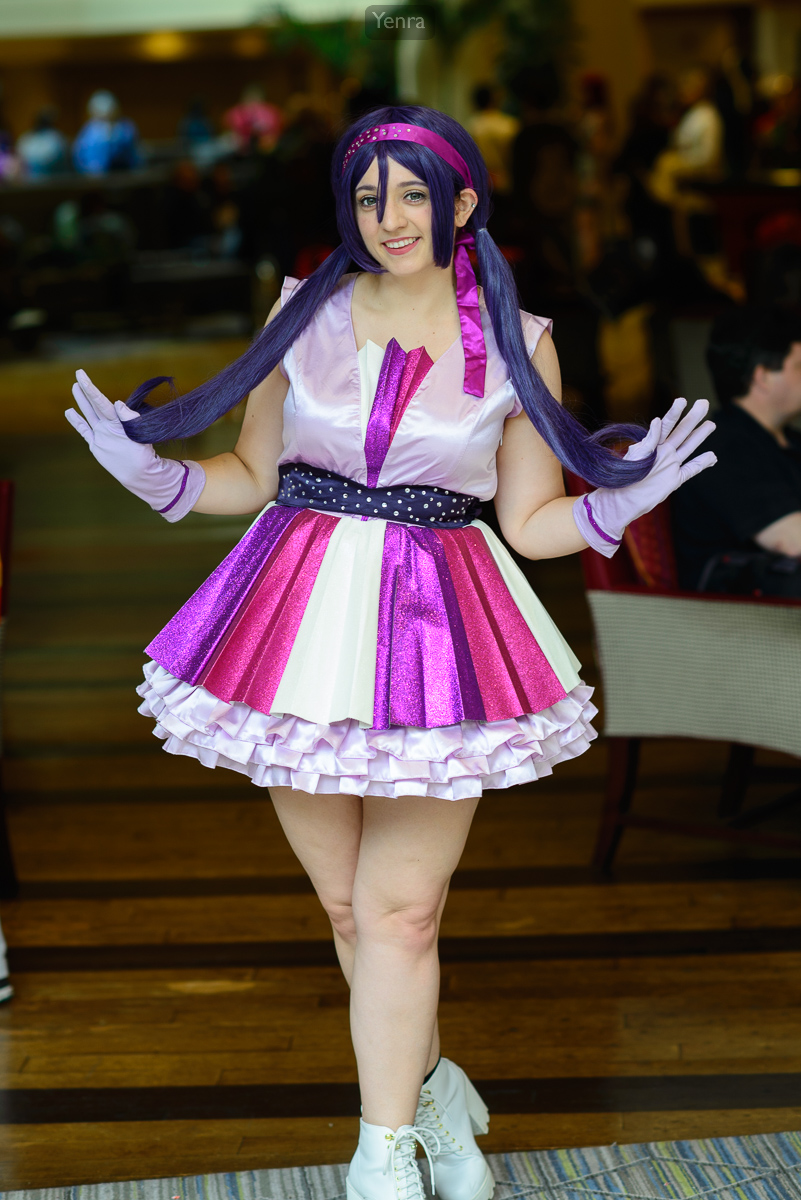
Nozomi Binetsu Kara Mystery · Photograph: Yenra
Captured: 2016:10:23 12:54:58
Rows of pale lavender ruffles run beneath the bright pleated skirt in this Nozomi Binetsu Kara Mystery portrait. The longer folds above travel downward; the small frills below repeat around the hem. Both are visible within the standing figure.
Move your attention between those two kinds of edge. The brighter panels offer longer paths, while the ruffles introduce shorter repeated curves. Notice where the pale fabric stands out against the darker surroundings and where the layers meet one another.
In a photograph of your own, compare a detailed edge with a larger, simpler area nearby. A frilled cuff next to a sleeve or a gathered cloth beside a plain surface can offer a similar starting point. Describe the shapes in everyday words.
Look for small curves near the face

Fairy Tale Kotori · Photograph: Yenra
Captured: 2016:10:23 12:56:58
The closer Fairy Tale Kotori portrait gives the white neckline and sleeve ruffles a larger place in the frame. Their curves sit near the face and raised hand, while the blue bodice provides a neighboring area of color.
Follow the sleeve edge, then return to the face. Notice how the closer framing changes the scale of the clothing detail. The whole skirt is no longer needed for these small curves to contribute to the portrait.
If you make a new photograph, try both a whole view and a closer composition. Keep both complete frames and compare which details become easier to notice. A piece of fabric on a chair can provide the same kind of experiment without arranging a portrait session.
Keep one small discovery
A useful note might describe a layered outline, a contrast between long folds and short curves, or a ruffle beside a face. Each is a different way of connecting detail with the whole picture.
Let your observation remain open. Another look may draw you toward a different edge, and that gives you another possible photograph to try.
Look back with curiosity.
- Which small edge catches your attention?
- How does it contribute to the whole portrait?
- What changes when you look closer?
Keep exploring
Noticing fabric folds in a photograph · Noticing decorative borders in a photograph · Seeing clothing as shape
Browse the complete Anime USA 2016 Sunday gallery.