Field notes · Look · Try · Compare
Choosing where to focus in a mirror portrait
Choose the reflected or directly seen face as your focus, then compare.
Velma Dinkley, Scooby Doo · Photograph: Yenra · Credit: Kaymm
Captured: 2018:01:07 12:45:46
A mirror portrait gives you a useful choice: the reflected face can lead the picture, or the face seen directly can become its clearest point. Choose one to focus on, look at the result, and try another version. The comparison can help you discover what you want a viewer to notice first.
Begin with the reflected face
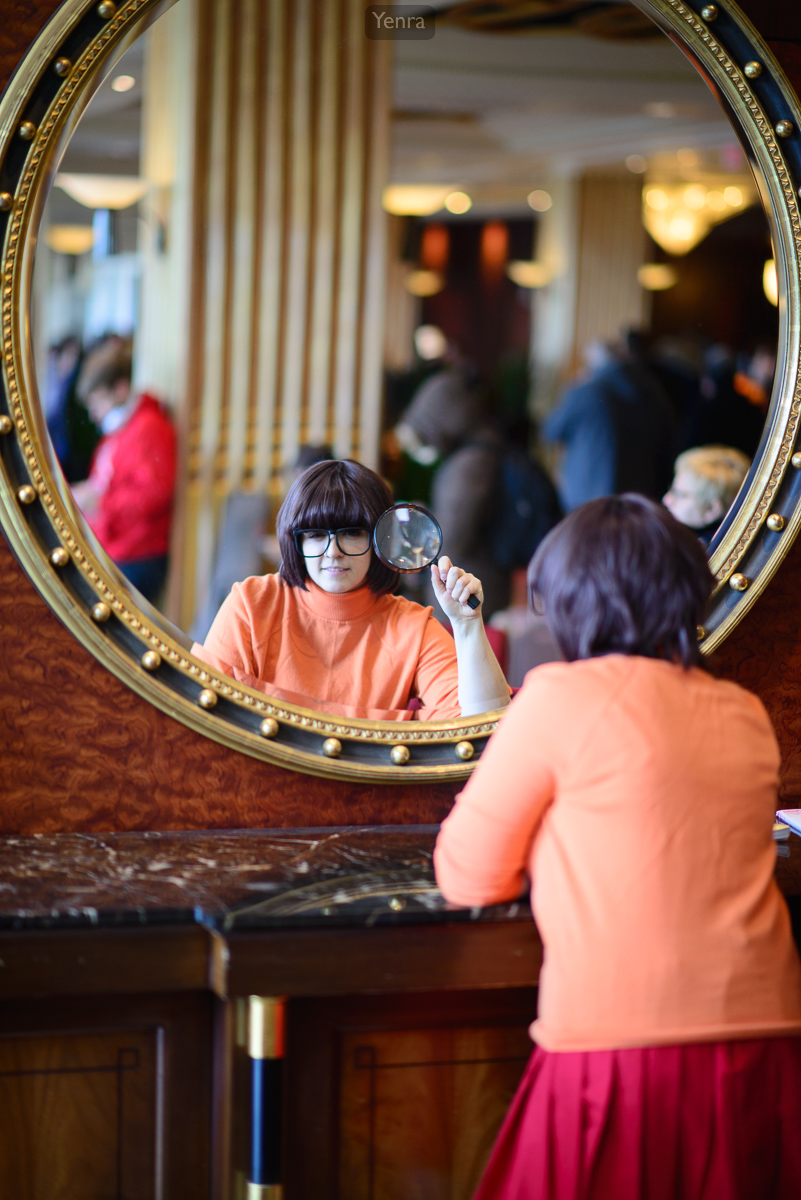
Kaymm appears here as Velma Dinkley. The round mirror holds the face and a raised magnifying glass, while the back of the orange sweater fills part of the foreground. The reflected face appears clearer than that nearer view of the model.
Look at the eyes inside the mirror, then the softer hair in front of it. Those two views belong to the same person, but they contribute differently. The foreground helps you understand where the model stands; the reflection gives you a face to meet.
For your own portrait, begin with a stable mirror already in place. Invite your model to choose a comfortable position. Move a little until you can see the reflection you want, checking the reflected room as well as the space directly in front of the camera.
Choose the reflected face as your focus target, make a photograph, and check whether that face is sharp. If your camera offers a movable focus point or your phone lets you tap to focus, use that choice deliberately. Look at the resulting image rather than assuming the camera chose the face you intended.
Keep the reflected face as your focus
Velma Dinkley, Scooby Doo · Photograph: Yenra · Credit: Kaymm
Captured: 2018:01:07 12:46:13
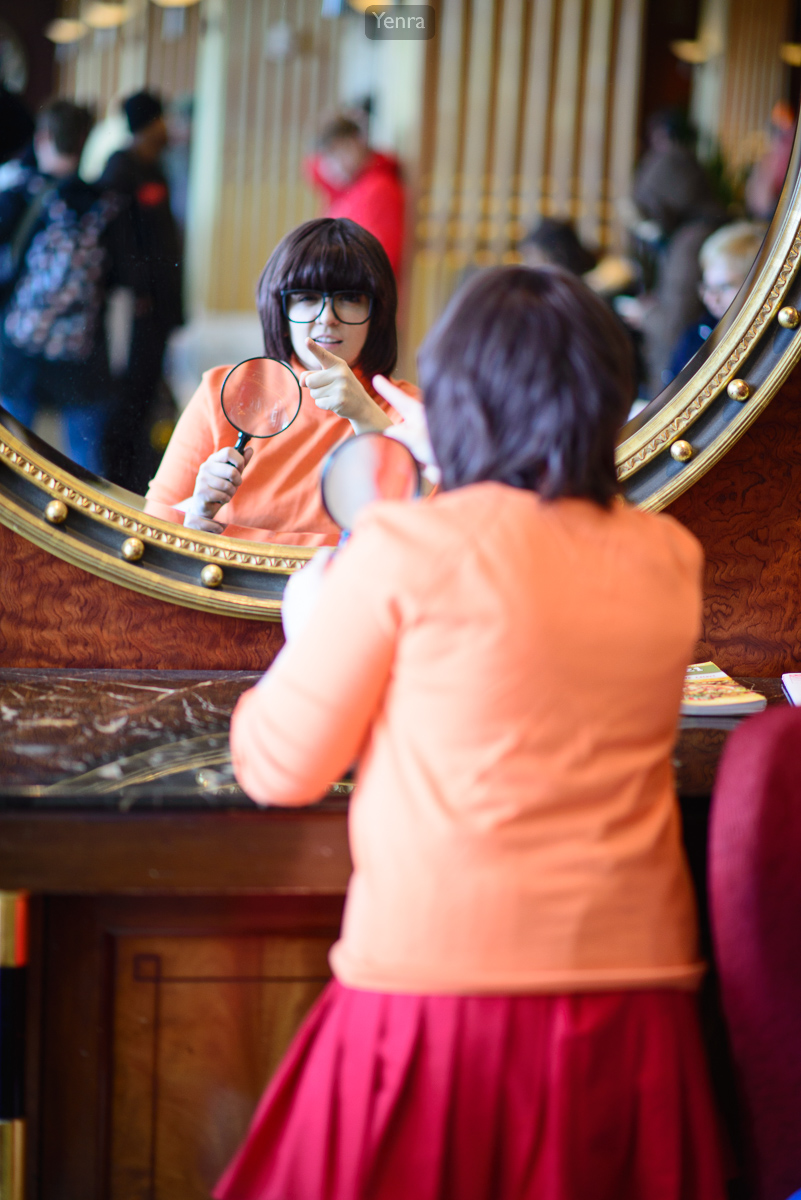
The second photograph includes a pointing hand and the magnifying glass within the reflection. The back of the model remains a softer foreground shape. A small gesture gives the two views another connection to follow.
Notice how much the reflection contains: a face, hands, the curved mirror edge and other people farther behind. A clear focus choice can give you an entry point even when the scene has several layers.
Try one comfortable gesture while keeping your attention on the reflected face. Check the result again after a movement. The reflected face and the directly seen model may lie at different focus distances, so you can let one remain softer while the other receives attention.
A prop is optional. A hand resting near a shoulder or a small change of gaze can be enough. Let your model suggest a variation and keep the process relaxed. You are exploring a choice together, rather than trying to reproduce someone else's expression.
Try a direct look with the mirror behind
Velma Dinkley, Scooby Doo · Photograph: Yenra · Credit: Kaymm
Captured: 2018:01:07 12:46:21
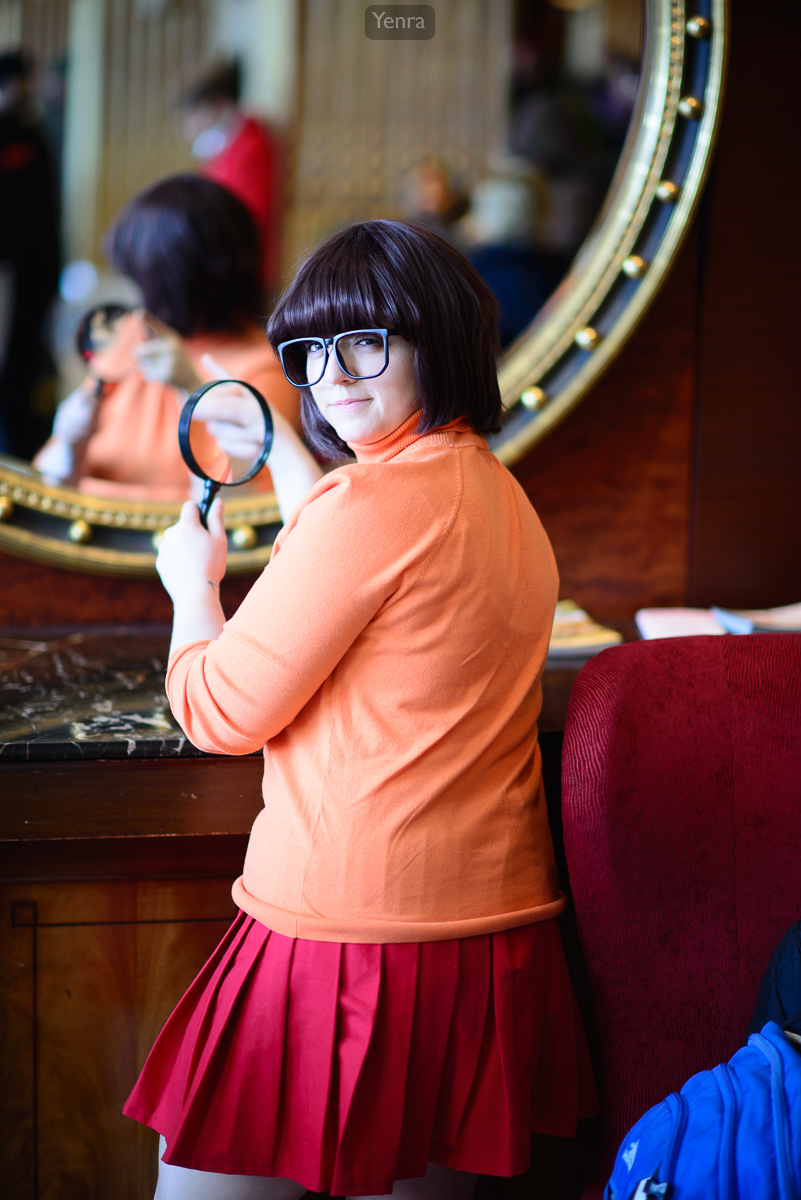
In this view, the model turns toward the camera. The directly seen face is now clearer, while the mirror gives another, softer view of the head and sweater. The mirror continues to contribute even though its face is no longer the main focus.
Invite a comfortable turn of your own and select the directly seen face as the focus target. Make another photograph and compare it with the reflected version. Which face catches your eye first? What does the softer view add?
These archive photographs differ in gesture and framing as well as apparent sharpness. They show possibilities to explore; they do not establish an original autofocus mode or a focus-only test. Your own pair can be a simple experiment with the equipment you already use.
Review the two pictures with your model. You may enjoy the reflected version, the direct version, or the relationship between them. Keep one note about the focus choice you would like to try again. There is room for both approaches in a portrait session.
Look back with curiosity.
- Which version of the face draws your eye first?
- What does the mirror add to the setting?
- Which face would you choose to focus on in another attempt?
Keep exploring
Noticing reflections in a photograph · Exploring gaze in a portrait · Noticing where a photograph is sharp
Browse the complete MAGFest 2018 gallery.